
The Biggest Renovation Mistake Isn't Choosing the Wrong Tiles. It's Starting Without a Plan.
February 1, 2026
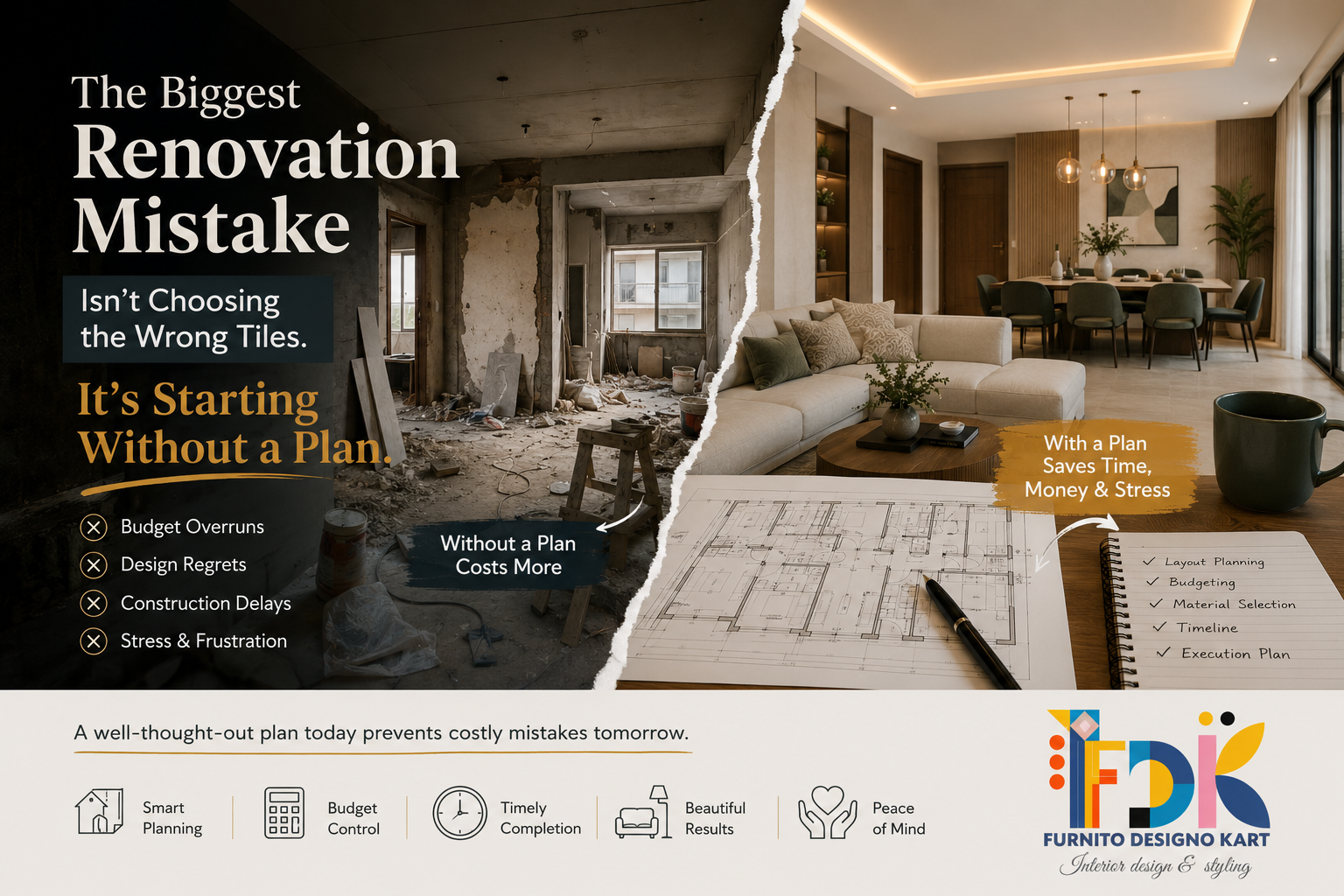
# We Thought Renovating Our Home Would Be Exciting…
...until it actually began.
Like most homeowners, we started with dreams.
Pinterest boards filled with beautiful living rooms.
Instagram reels showcasing luxurious modular kitchens.
Saved photos of elegant bedrooms with soft lighting and cozy reading corners.
Every weekend became another opportunity to imagine what our future home could look like.
Then came the first quotation.
Followed by another.
Then another contractor.
Another suggestion.
Another opinion.
Within a few weeks, the excitement that once surrounded our dream home slowly transformed into confusion.
Should we begin with flooring?
Or should electrical work happen first?
Can we finalize the kitchen later?
Do we really need detailed drawings?
Is hiring an interior designer worth the additional expense?
Or should we simply hire a contractor and make decisions as we go?
If these questions sound familiar, you're not alone.
After working with homeowners from different backgrounds—young couples moving into their first apartment, growing families renovating older homes, and professionals upgrading builder floors—I have noticed one common pattern.
The biggest renovation mistake isn't choosing the wrong tiles.
It isn't selecting the wrong paint colour.
It isn't even overspending.
The biggest mistake is beginning without a clear plan.
And unfortunately, that single mistake triggers almost every other problem during renovation.
---
# Why Most Renovations Become Stressful
Nobody plans for a stressful renovation.
Yet thousands of homeowners experience exactly that.
Budgets exceed expectations.
Timelines stretch for months.
Contractors blame suppliers.
Suppliers blame labour.
Labour blames the weather.
Somewhere in between, the homeowner is left wondering:
*"Why is this becoming so difficult?"*
The truth is simple.
Renovation isn't complicated because of construction.
It's complicated because of decisions.
A typical home renovation involves hundreds of decisions.
Which flooring should you choose?
How many electrical sockets do you actually need?
Should the wardrobe doors be sliding or hinged?
Where should the washing machine go?
Will sunlight fade the wooden flooring?
Can the TV wall support natural stone?
Should you spend more on lighting or furniture?
Each of these decisions affects another.
When they are taken in isolation instead of as part of a larger plan, expensive mistakes begin to appear.
That's why successful renovations aren't built on expensive materials.
They're built on thoughtful planning.
---
# The Myth That Costs Homeowners Lakhs
One sentence is responsible for countless renovation disasters.
> "We'll figure it out during the work."
It sounds practical.
Flexible.
Even economical.
But in reality, this approach often leads to repeated work, unnecessary purchases, delays, and frustration.
Imagine baking a cake.
Halfway through, you decide to change the recipe.
Then you realise you forgot eggs.
Later you decide the oven temperature should have been different.
The result is predictable.
Home renovation works exactly the same way.
Every late decision becomes an expensive decision.
---
# A Conversation That Happens More Often Than You Think
One afternoon, a homeowner called us after the flooring had already been completed.
Everything looked beautiful.
Large-format tiles.
Freshly painted walls.
Modern finishes.
But there was one problem.
The modular wardrobe couldn't open properly because the bed layout had never been planned before the flooring and electrical points were finalized.
Now there were only two choices.
Redo the wardrobe.
Or shift electrical points and modify the flooring.
Both options meant additional cost.
Neither was necessary.
A simple furniture layout prepared before renovation would have prevented the entire situation.
This wasn't because anyone lacked skill.
It happened because nobody had looked at the home as one complete system.
---
# Mistake #1: Starting Demolition Before Completing the Design
One of the most common things homeowners say is:
*"Let's begin the demolition. We'll finalize the rest later."*
It feels productive.
Work has started.
Progress is visible.
But demolition without complete planning is like driving without knowing the destination.
You might move quickly.
But not necessarily in the right direction.
Before a single wall is broken, every major decision should ideally be made.
That includes:
* Furniture layout
* Kitchen planning
* Electrical points
* Lighting positions
* Plumbing modifications
* Ceiling design
* Air-conditioning requirements
* Storage planning
Each of these decisions influences the others.
Changing one later often affects several completed works.
---
## Why This Happens
Most people underestimate how interconnected a home really is.
Moving a kitchen sink may affect plumbing.
Plumbing changes affect flooring.
Flooring affects cabinet measurements.
Cabinets influence lighting.
Lighting impacts ceiling design.
One small change creates a chain reaction.
Planning first doesn't slow down renovation.
It actually speeds it up.
---
## A Better Approach
Before any demolition begins, ask yourself these questions:
✔ Where will every major piece of furniture go?
✔ Have all electrical points been finalized?
✔ Are appliance sizes confirmed?
✔ Is the storage sufficient for our family?
✔ Have we decided on flooring?
✔ Are all wall modifications approved?
If the answer to most of these is "not yet," you're probably not ready to begin demolition.
---
# Mistake #2: Designing for Instagram Instead of Your Lifestyle
Social media has changed the way we imagine our homes.
That's not necessarily a bad thing.
Beautiful spaces inspire creativity.
They help us discover colours, materials, and layouts we may never have considered.
The problem begins when inspiration replaces planning.
A home should never be designed to impress strangers on the internet.
It should be designed to support the people who live in it every day.
Think about it.
A white boucle sofa may look stunning in a photograph.
But what happens if you have two energetic children who love painting?
Or a Labrador that jumps onto the couch every evening?
Or elderly parents who need firm seating?
A beautiful home isn't one that copies trends.
It's one that quietly works for your everyday life.
---
## Ask Better Questions
Instead of asking:
*"Is this trending?"*
Ask:
* Will this be easy to clean?
* Will it age well?
* Is it comfortable?
* Does it suit our family?
* Will we still like it five years from now?
Those questions usually lead to better decisions than any viral reel.
---
# Mistake #3: Ignoring Storage Until the End
Every homeowner wants a spacious home.
Ironically, many lose that spacious feeling within months of moving in.
Not because the house became smaller.
But because everyday items had nowhere to go.
Children's toys.
Cleaning supplies.
Seasonal decorations.
Extra bedding.
Suitcases.
Documents.
Shoes.
Sports equipment.
They all need a place.
Storage isn't glamorous.
It won't receive thousands of likes on social media.
But it quietly determines whether your home feels calm or cluttered.
Good storage is almost invisible.
It blends into the design.
It reduces visual noise.
It makes cleaning easier.
Most importantly, it allows your home to evolve as your family grows.
---
# A Home Should Reduce Stress, Not Add to It
One of the greatest misconceptions about interior design is that it's mainly about aesthetics.
Beautiful homes matter.
But beauty alone doesn't improve daily life.
Thoughtful design does.
A well-planned home saves time every morning.
Makes cooking easier.
Keeps belongings organized.
Improves movement.
Supports children.
Makes ageing parents feel safer.
Creates corners where conversations happen naturally.
These are the details that truly transform a house into a home.
And they all begin with planning.
---
# Before You Start Your Renovation, Pause for a Moment
Ask yourself:
* Do I have a complete plan?
* Have I considered how my family actually lives?
* Am I making decisions in the right sequence?
* Will today's shortcut become tomorrow's expense?
If you're unsure, that's perfectly normal.
Renovating a home is something most people do only a few times in their lives.
Seeking guidance before starting isn't an extra expense.
It's often the smartest investment you can make.
---
## Frequently Asked Questions
### Is hiring an interior designer necessary for a small renovation?
Not always for execution, but even a short design consultation can help you avoid expensive mistakes, improve layouts, and prioritize where to spend your budget.
### When should I start planning my home renovation?
Ideally, before you contact contractors or begin demolition. Early planning gives you clarity on layout, budget, materials, and timelines.
### Can I renovate my home in phases?
Yes. Many homeowners renovate in stages. The key is to create one comprehensive master plan first, so each phase fits seamlessly into the next.
### What's the biggest mistake first-time homeowners make?
Starting work without a complete design plan. This often leads to repeated work, budget overruns, and delays that could have been avoided.
---
Looking to renovate your home ?
Choose from our easy to pick online fixed price services !
Click here https://furnitodesignokart.com/services
**Coming Up in Part 2:** We'll explore why choosing materials too early, delaying lighting decisions, and relying on multiple contractors without a coordinated plan can turn a straightforward renovation into an expensive ordeal—and how you can avoid those pitfalls.
...until it actually began.
Like most homeowners, we started with dreams.
Pinterest boards filled with beautiful living rooms.
Instagram reels showcasing luxurious modular kitchens.
Saved photos of elegant bedrooms with soft lighting and cozy reading corners.
Every weekend became another opportunity to imagine what our future home could look like.
Then came the first quotation.
Followed by another.
Then another contractor.
Another suggestion.
Another opinion.
Within a few weeks, the excitement that once surrounded our dream home slowly transformed into confusion.
Should we begin with flooring?
Or should electrical work happen first?
Can we finalize the kitchen later?
Do we really need detailed drawings?
Is hiring an interior designer worth the additional expense?
Or should we simply hire a contractor and make decisions as we go?
If these questions sound familiar, you're not alone.
After working with homeowners from different backgrounds—young couples moving into their first apartment, growing families renovating older homes, and professionals upgrading builder floors—I have noticed one common pattern.
The biggest renovation mistake isn't choosing the wrong tiles.
It isn't selecting the wrong paint colour.
It isn't even overspending.
The biggest mistake is beginning without a clear plan.
And unfortunately, that single mistake triggers almost every other problem during renovation.
---
# Why Most Renovations Become Stressful
Nobody plans for a stressful renovation.
Yet thousands of homeowners experience exactly that.
Budgets exceed expectations.
Timelines stretch for months.
Contractors blame suppliers.
Suppliers blame labour.
Labour blames the weather.
Somewhere in between, the homeowner is left wondering:
*"Why is this becoming so difficult?"*
The truth is simple.
Renovation isn't complicated because of construction.
It's complicated because of decisions.
A typical home renovation involves hundreds of decisions.
Which flooring should you choose?
How many electrical sockets do you actually need?
Should the wardrobe doors be sliding or hinged?
Where should the washing machine go?
Will sunlight fade the wooden flooring?
Can the TV wall support natural stone?
Should you spend more on lighting or furniture?
Each of these decisions affects another.
When they are taken in isolation instead of as part of a larger plan, expensive mistakes begin to appear.
That's why successful renovations aren't built on expensive materials.
They're built on thoughtful planning.
---
# The Myth That Costs Homeowners Lakhs
One sentence is responsible for countless renovation disasters.
> "We'll figure it out during the work."
It sounds practical.
Flexible.
Even economical.
But in reality, this approach often leads to repeated work, unnecessary purchases, delays, and frustration.
Imagine baking a cake.
Halfway through, you decide to change the recipe.
Then you realise you forgot eggs.
Later you decide the oven temperature should have been different.
The result is predictable.
Home renovation works exactly the same way.
Every late decision becomes an expensive decision.
---
# A Conversation That Happens More Often Than You Think
One afternoon, a homeowner called us after the flooring had already been completed.
Everything looked beautiful.
Large-format tiles.
Freshly painted walls.
Modern finishes.
But there was one problem.
The modular wardrobe couldn't open properly because the bed layout had never been planned before the flooring and electrical points were finalized.
Now there were only two choices.
Redo the wardrobe.
Or shift electrical points and modify the flooring.
Both options meant additional cost.
Neither was necessary.
A simple furniture layout prepared before renovation would have prevented the entire situation.
This wasn't because anyone lacked skill.
It happened because nobody had looked at the home as one complete system.
---
# Mistake #1: Starting Demolition Before Completing the Design
One of the most common things homeowners say is:
*"Let's begin the demolition. We'll finalize the rest later."*
It feels productive.
Work has started.
Progress is visible.
But demolition without complete planning is like driving without knowing the destination.
You might move quickly.
But not necessarily in the right direction.
Before a single wall is broken, every major decision should ideally be made.
That includes:
* Furniture layout
* Kitchen planning
* Electrical points
* Lighting positions
* Plumbing modifications
* Ceiling design
* Air-conditioning requirements
* Storage planning
Each of these decisions influences the others.
Changing one later often affects several completed works.
---
## Why This Happens
Most people underestimate how interconnected a home really is.
Moving a kitchen sink may affect plumbing.
Plumbing changes affect flooring.
Flooring affects cabinet measurements.
Cabinets influence lighting.
Lighting impacts ceiling design.
One small change creates a chain reaction.
Planning first doesn't slow down renovation.
It actually speeds it up.
---
## A Better Approach
Before any demolition begins, ask yourself these questions:
✔ Where will every major piece of furniture go?
✔ Have all electrical points been finalized?
✔ Are appliance sizes confirmed?
✔ Is the storage sufficient for our family?
✔ Have we decided on flooring?
✔ Are all wall modifications approved?
If the answer to most of these is "not yet," you're probably not ready to begin demolition.
---
# Mistake #2: Designing for Instagram Instead of Your Lifestyle
Social media has changed the way we imagine our homes.
That's not necessarily a bad thing.
Beautiful spaces inspire creativity.
They help us discover colours, materials, and layouts we may never have considered.
The problem begins when inspiration replaces planning.
A home should never be designed to impress strangers on the internet.
It should be designed to support the people who live in it every day.
Think about it.
A white boucle sofa may look stunning in a photograph.
But what happens if you have two energetic children who love painting?
Or a Labrador that jumps onto the couch every evening?
Or elderly parents who need firm seating?
A beautiful home isn't one that copies trends.
It's one that quietly works for your everyday life.
---
## Ask Better Questions
Instead of asking:
*"Is this trending?"*
Ask:
* Will this be easy to clean?
* Will it age well?
* Is it comfortable?
* Does it suit our family?
* Will we still like it five years from now?
Those questions usually lead to better decisions than any viral reel.
---
# Mistake #3: Ignoring Storage Until the End
Every homeowner wants a spacious home.
Ironically, many lose that spacious feeling within months of moving in.
Not because the house became smaller.
But because everyday items had nowhere to go.
Children's toys.
Cleaning supplies.
Seasonal decorations.
Extra bedding.
Suitcases.
Documents.
Shoes.
Sports equipment.
They all need a place.
Storage isn't glamorous.
It won't receive thousands of likes on social media.
But it quietly determines whether your home feels calm or cluttered.
Good storage is almost invisible.
It blends into the design.
It reduces visual noise.
It makes cleaning easier.
Most importantly, it allows your home to evolve as your family grows.
---
# A Home Should Reduce Stress, Not Add to It
One of the greatest misconceptions about interior design is that it's mainly about aesthetics.
Beautiful homes matter.
But beauty alone doesn't improve daily life.
Thoughtful design does.
A well-planned home saves time every morning.
Makes cooking easier.
Keeps belongings organized.
Improves movement.
Supports children.
Makes ageing parents feel safer.
Creates corners where conversations happen naturally.
These are the details that truly transform a house into a home.
And they all begin with planning.
---
# Before You Start Your Renovation, Pause for a Moment
Ask yourself:
* Do I have a complete plan?
* Have I considered how my family actually lives?
* Am I making decisions in the right sequence?
* Will today's shortcut become tomorrow's expense?
If you're unsure, that's perfectly normal.
Renovating a home is something most people do only a few times in their lives.
Seeking guidance before starting isn't an extra expense.
It's often the smartest investment you can make.
---
## Frequently Asked Questions
### Is hiring an interior designer necessary for a small renovation?
Not always for execution, but even a short design consultation can help you avoid expensive mistakes, improve layouts, and prioritize where to spend your budget.
### When should I start planning my home renovation?
Ideally, before you contact contractors or begin demolition. Early planning gives you clarity on layout, budget, materials, and timelines.
### Can I renovate my home in phases?
Yes. Many homeowners renovate in stages. The key is to create one comprehensive master plan first, so each phase fits seamlessly into the next.
### What's the biggest mistake first-time homeowners make?
Starting work without a complete design plan. This often leads to repeated work, budget overruns, and delays that could have been avoided.
---
Looking to renovate your home ?
Choose from our easy to pick online fixed price services !
Click here https://furnitodesignokart.com/services
**Coming Up in Part 2:** We'll explore why choosing materials too early, delaying lighting decisions, and relying on multiple contractors without a coordinated plan can turn a straightforward renovation into an expensive ordeal—and how you can avoid those pitfalls.