
Designing with Intention: How Thoughtful Interior Design Can Create Kinder, More Human Homes
August 10, 2026
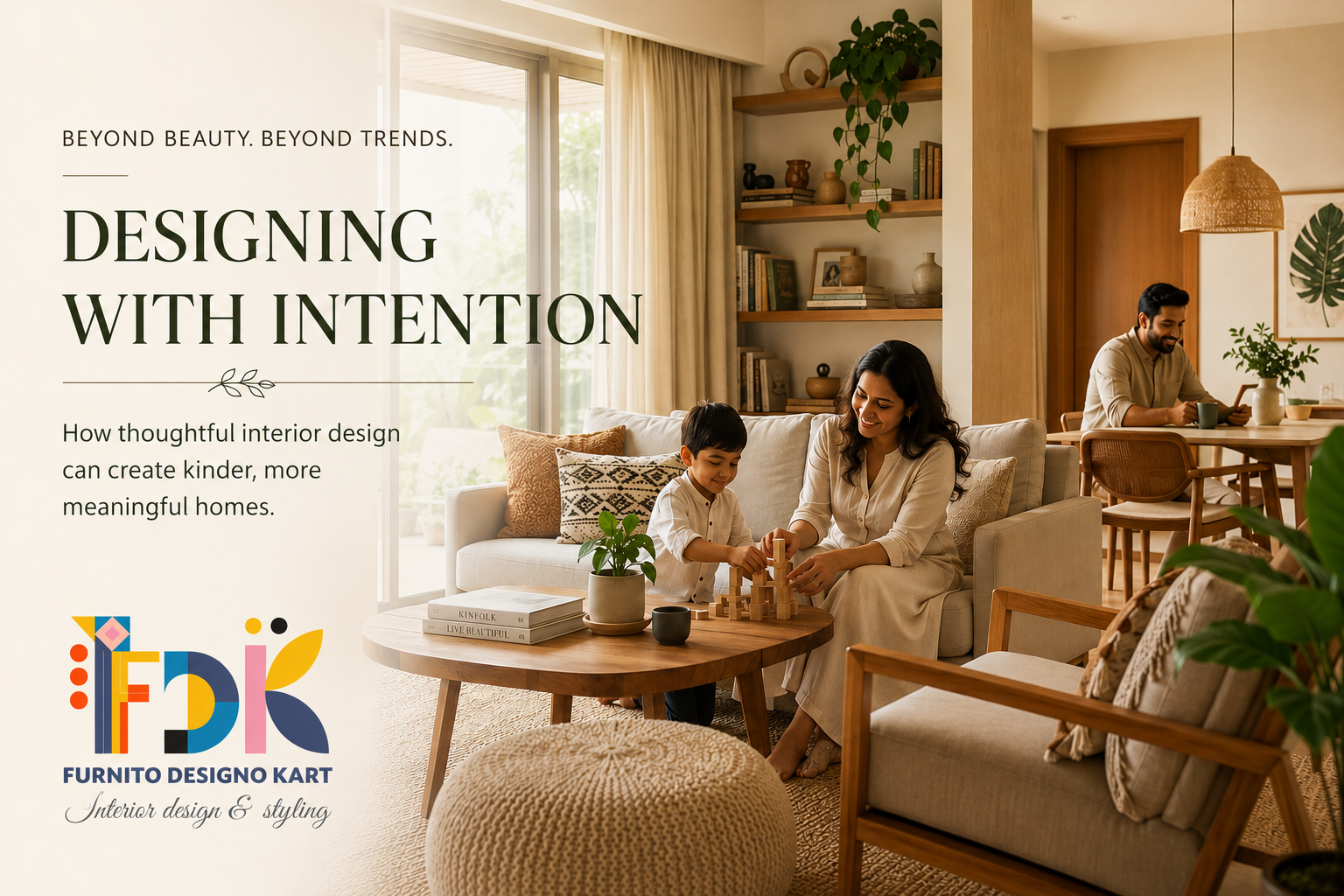
"A home is more than the walls that contain our lives. It is the environment in which our habits are formed, our relationships unfold, our children grow, our elders age, and our memories are created."
As an interior designer, I have gradually come to believe that designing a beautiful home is only one part of my responsibility.
The deeper responsibility is to ask:
What kind of life will this home encourage?
What will a person feel when they wake up here?
Will the home make everyday life easier for an elderly parent?
Will a child find spaces that encourage curiosity and independence?
Will a busy couple find moments of calm rather than another source of clutter and stress?
Will the home encourage people to sit together, talk to one another and share meals?
Will it make the people living in it feel cared for?
These questions have changed the way I approach -interior design and home decor.
I no longer see design simply as selecting colours, furniture, lighting, finishes and accessories. I see it as an opportunity to quietly influence the quality of human life.
That is what I mean by designing with intention.
---
1. What Does It Mean to Design with Intention?
Intentional interior design begins with understanding that every design decision has a purpose.
A beautiful sofa is not just a sofa.
Its size, depth, placement and material can determine whether a family sits together comfortably or whether everyone eventually retreats into separate corners.
A dining table is not merely a piece of furniture.
It can become the place where parents listen to their children, grandparents tell stories and families reconnect after a busy day.
A window is not simply an architectural opening.
It can become a source of morning light, ventilation, connection with nature and a reminder that there is a world beyond our screens.
Even something as simple as storage can influence the way a person feels.
When everyday objects have a place, the home becomes easier to maintain. When the home is easier to maintain, people experience less frustration. And sometimes, reducing small daily frustrations is itself an act of kindness.
This is why **thoughtful interior design** must begin with people—not Pinterest boards.
---
2. Designing for the Person Who Entrusts Their Home to You
When someone gives an interior designer the responsibility of designing their home, they are giving us much more than a floor plan.
They are trusting us with a deeply personal space.
They are sharing their routines, preferences, family dynamics, financial priorities and sometimes even their vulnerabilities.
Perhaps they tell us that their elderly parents will live with them.
Perhaps they tell us that their child struggles to keep their room organised.
Perhaps they work twelve hours a day and desperately want a home that feels peaceful when they return.
Perhaps they love entertaining friends.
Perhaps they don't.
Perhaps they have inherited furniture that has enormous sentimental value even though it doesn't fit neatly into the latest design trend.
Perhaps they have a limited budget but enormous dreams.
3.Good design begins when we listen to all of this without judgement.**
The job of a designer is not to impose a lifestyle on the client.
It is to understand the life that already exists—and then design an environment that supports it.
---
4. Beauty Should Never Come at the Cost of Humanity
The world of interiors can sometimes become obsessed with visual perfection.
Perfectly styled living rooms.
Perfectly coordinated colours.
Perfect coffee tables.
Perfectly placed books.
Perfectly minimal kitchens.
There is absolutely nothing wrong with beautiful spaces.
I love beautiful spaces.
But I believe a home should be allowed to look like people live there.
A child's artwork should have a place.
A grandmother's old chair may deserve to stay.
The dining table should be large enough for an unexpected guest.
There should be somewhere to sit while putting on shoes.
A bedroom should have enough storage that the person living in it doesn't have to fight clutter every morning.
A kitchen should be designed around the actual person who cooks in it—not simply around what looks good in a photograph.
These may sound like small decisions.
But **human-centred interior design is often built from small acts of consideration.**
---
4. Can Interior Design Teach Kindness?
I believe it can.
Not directly.
A room cannot tell someone, "Be kind."
But a thoughtfully designed environment can make kindness easier.
Imagine a home where the elderly parent doesn't have to climb onto a high stool to reach something.
A home where a child can independently put away their toys because storage has been designed at their height.
A home where there is a comfortable corner for a family member who needs some quiet time.
A home where guests don't feel uncomfortable because there is enough seating.
A home where the kitchen allows two people to work together without constantly getting in each other's way.
A home where there is a small place to pause, read, pray, reflect or simply breathe.
These choices communicate something.
They say:
**You matter.**
And perhaps that is one of the most powerful messages a home can communicate.
---
5. Designing for Relationships, Not Just Rooms
When I design a living room, I don't want to think only about the television wall, sofa and centre table.
I want to think about conversation.
Can people see each other when they are sitting?
Is the furniture arranged in a way that encourages interaction?
Can a child sit with their parents?
Can grandparents participate comfortably?
Can a guest feel welcomed rather than pushed into an isolated corner?
Similarly, when designing a dining space, I think about the ritual of eating together.
In our increasingly digital lives, the dining table can become one of the few places where people put their phones away and actually look at one another.
That makes its design more important than we sometimes realise.
**Interior design has the power to create opportunities for human connection.**
---
6. A Home Should Also Teach Children Something
One of the most beautiful responsibilities of designing a family home is recognising that children are constantly absorbing their environment.
They learn from what they see.
If everything in a home is disposable, they may learn disposability.
If every space is designed around consumption and display, they may learn that appearance is more important than meaning.
But if a home celebrates books, plants, handmade objects, family photographs, artwork and things made with care, it can communicate different values.
It can teach appreciation.
It can teach responsibility.
It can teach respect for craftsmanship.
It can teach children that things do not need to be new to be valuable.
A thoughtfully designed children's room, for example, can encourage independence by allowing the child to reach their books, organise their belongings and participate in maintaining their own space.
That is design with intention.
---
7. Designing for Elders Is an Act of Respect
Our homes must also acknowledge the passage of time.
A space that works beautifully for a young couple may not work equally well when their parents come to live with them—or when they themselves grow older.
Thoughtful **home design for seniors** considers accessibility, lighting, circulation, seating heights, storage, bathroom safety and ease of movement.
But beyond these technical considerations is something much more important:
**Dignity.**
Good design should allow an older person to remain as independent as possible.
They should not constantly have to ask someone else to reach, move, carry or adjust things for them.
This is where interior design becomes much more than aesthetics.
It becomes an expression of respect.
---
8. Kindness Can Also Be Sustainable
Intentional design naturally leads us towards more responsible choices.
Instead of asking:
*"What is trending?"*
we can ask:
*"What will still make sense five or ten years from now?"*
Instead of replacing everything, can we reuse something?
Can an existing piece of furniture be restored?
Can we choose durable materials rather than finishes that need constant replacement?
Can we design enough storage to prevent unnecessary purchases?
Can we use natural light effectively before adding excessive artificial lighting?
Can we choose products from responsible makers and artisans?
**Sustainable interior design is not only about materials. It is also about reducing waste, respecting resources and designing for longevity.**
Sometimes the most sustainable design decision is simply to buy less—and choose better.
---
9. The Designer's Role Is Not to Create a Showroom
A home should never feel like a showroom that its residents are afraid to touch.
It should feel alive.
It should accommodate morning chaos, children's homework, family celebrations, lazy Sundays, unexpected guests, festivals, arguments, laughter and quiet evenings.
Real life is not perfectly styled.
And neither should every home be.
As designers, we need to understand the difference between designing for a photograph and designing for a life.
A photograph lasts a moment.
A home is lived in for years.
**Our designs should therefore be judged not only by how they look on the day of handover, but by how well they serve the people living there years later.**
---
10. Bringing Human Values into My Own Design Process
For me, designing with intention means incorporating a few questions into the design process.
### 1. Who is going to live here?
Not just how many people—but who they are.
Their ages, routines, habits, work patterns, hobbies and relationships all matter.
### 2. What makes their everyday life difficult?
Sometimes the best design solution is not a decorative feature.
It may be better storage.
Better lighting.
A wider passage.
A more practical kitchen.
A place for keys.
A comfortable chair.
Good design often solves problems that people have stopped noticing because they have become part of everyday life.
### 3. What should this home make them feel?
Calm?
Energetic?
Connected?
Safe?
Creative?
Grounded?
Welcomed?
The emotional experience of a space should be considered alongside its visual appearance.
### 4. What values can this home quietly reinforce?
Respect for nature.
Love for family.
Independence.
Simplicity.
Creativity.
Hospitality.
Gratitude.
These values don't need to be written on the walls.
They can be embedded into the way the home functions.
### 5. What can we preserve?
Before replacing something, I believe we should ask whether it has a story.
A piece of furniture inherited from a parent may not be "perfect" aesthetically, but its emotional value may be far greater than that of an expensive new piece.
A good designer should know when to introduce something new—and when to protect something old.
---
# The Invisible Layer of Interior Design
There is a visible layer to every interior.
Colours.
Textures.
Furniture.
Lighting.
Art.
Materials.
But there is also an invisible layer.
It is the feeling of entering a home and immediately feeling welcome.
It is the ease with which someone finds what they need.
It is the comfort of an elderly parent sitting in their favourite chair.
It is a child being able to reach their books.
It is friends gathering around a dining table.
It is a couple finding a quiet corner after a long day.
It is the family photograph that has been given a place of honour.
It is the old object that was not discarded because somebody loved it.
**This invisible layer is where the humanity of design lives.**
---
# Designing Homes That Give Something Back
As an interior designer, I don't want my work to end with a beautiful photograph or a successful project handover.
I want the homes I design to give something back to the people who live in them.
I want them to make mornings a little easier.
Evenings a little calmer.
Families a little more connected.
Children a little more independent.
Elders a little more comfortable.
Guests a little more welcome.
And perhaps, in some small way, the people living there a little more considerate of one another.
That may sound like a very ambitious expectation from interior design.
But I believe design influences behaviour far more than we realise.
The environments we inhabit become part of our everyday experiences. And our everyday experiences gradually shape us.
So perhaps the question we should ask as designers is not merely:
**"Does this space look beautiful?"**
Perhaps we should also ask:
**"Does this space help the people living here become the people they want to be?"**
---
# Designing With Intention Is Designing With Responsibility
Every client who trusts a designer with their home gives that designer an extraordinary opportunity.
We are given the chance to influence someone's everyday life.
That responsibility deserves more than following trends.
It deserves listening.
Empathy.
Curiosity.
Restraint.
Respect.
And kindness.
The best interior design, in my opinion, is not necessarily the most expensive, the most luxurious or the most Instagram-worthy.
It is the design that understands its people.
It is the design that solves problems before they become frustrations.
It is the design that respects age, ability, budget and lifestyle.
It is the design that leaves room for memories.
It is the design that allows people to live—not merely display their lives.
And ultimately, it is the design that makes a house feel like it was created **for someone**, rather than simply created **by someone**.
## Because a home should not only reflect who we are.
**It should quietly help us become better versions of ourselves.**
And that, to me, is the true meaning of **designing with intention**.
---
## Frequently Asked Questions
### What is intentional interior design?
Intentional interior design is an approach where every design decision is made with the people, lifestyle, needs and values of the occupants in mind. Instead of designing purely for aesthetics or trends, the designer considers how the space will influence comfort, functionality, relationships and everyday life.
### Why is human-centred interior design important?
Human-centred interior design focuses on the actual people using a space. It considers their routines, physical abilities, emotional needs, family relationships and lifestyle. This can make a home more comfortable, accessible, functional and meaningful.
### How can interior design encourage kindness?
Design can make considerate behaviour easier by creating spaces that support different family members. Accessible storage, comfortable seating, welcoming common areas, child-friendly organisation and spaces for quiet reflection are examples of design choices that communicate care and consideration.
### How can a designer make a home more meaningful?
A designer can incorporate meaningful objects, family heirlooms, artwork, photographs, books, handmade products and materials that reflect the homeowner's story. The goal is to create a home that represents the people living there rather than simply following a particular design trend.
### What is sustainable interior design?
Sustainable interior design focuses on making responsible choices regarding materials, durability, reuse, energy efficiency and consumption. Designing for longevity and avoiding unnecessary replacement can be as important as selecting environmentally responsible materials.
### How can interior design benefit children?
A thoughtfully designed home can encourage children's independence, creativity and responsibility. Accessible storage, dedicated spaces for reading and learning, organised play areas and opportunities to interact with nature can help children develop positive habits.
### How should homes be designed for elderly parents?
Homes for elderly family members should prioritise safety, accessibility, comfort and independence. Good lighting, easy circulation, appropriate furniture heights, accessible storage and safer bathrooms can significantly improve everyday living while preserving dignity.
### What should an interior designer ask a client before designing their home?
A designer should understand who lives in the home, how they spend their day, what challenges they face, what they value, what they love, what they want to preserve and what they want their home to feel like. These insights are often more valuable than simply asking which colour or style they prefer.
### Can a beautiful home also be practical?
Absolutely. In fact, the best interior design combines aesthetics with functionality. A beautiful space that is difficult to maintain or uncomfortable to use may not remain beautiful for long. Practicality allows the design to continue working as the family lives in and grows within the home.
### What makes a home feel human?
A home feels human when it reflects the people who live there. Personal objects, comfortable spaces, meaningful memories, natural materials, family photographs, books, artwork and thoughtful functionality can all contribute to a sense of warmth, belonging and individuality.
---
## Final Thought
**Interior design is not just about creating spaces that people admire.**
It is about creating spaces that care for the people who inhabit them.
When we design with empathy, intention and responsibility, we are not merely designing interiors.
**We are helping design the everyday lives that happen inside them.**
*— Furnito Designo Kart*
As an interior designer, I have gradually come to believe that designing a beautiful home is only one part of my responsibility.
The deeper responsibility is to ask:
What kind of life will this home encourage?
What will a person feel when they wake up here?
Will the home make everyday life easier for an elderly parent?
Will a child find spaces that encourage curiosity and independence?
Will a busy couple find moments of calm rather than another source of clutter and stress?
Will the home encourage people to sit together, talk to one another and share meals?
Will it make the people living in it feel cared for?
These questions have changed the way I approach -interior design and home decor.
I no longer see design simply as selecting colours, furniture, lighting, finishes and accessories. I see it as an opportunity to quietly influence the quality of human life.
That is what I mean by designing with intention.
---
1. What Does It Mean to Design with Intention?
Intentional interior design begins with understanding that every design decision has a purpose.
A beautiful sofa is not just a sofa.
Its size, depth, placement and material can determine whether a family sits together comfortably or whether everyone eventually retreats into separate corners.
A dining table is not merely a piece of furniture.
It can become the place where parents listen to their children, grandparents tell stories and families reconnect after a busy day.
A window is not simply an architectural opening.
It can become a source of morning light, ventilation, connection with nature and a reminder that there is a world beyond our screens.
Even something as simple as storage can influence the way a person feels.
When everyday objects have a place, the home becomes easier to maintain. When the home is easier to maintain, people experience less frustration. And sometimes, reducing small daily frustrations is itself an act of kindness.
This is why **thoughtful interior design** must begin with people—not Pinterest boards.
---
2. Designing for the Person Who Entrusts Their Home to You
When someone gives an interior designer the responsibility of designing their home, they are giving us much more than a floor plan.
They are trusting us with a deeply personal space.
They are sharing their routines, preferences, family dynamics, financial priorities and sometimes even their vulnerabilities.
Perhaps they tell us that their elderly parents will live with them.
Perhaps they tell us that their child struggles to keep their room organised.
Perhaps they work twelve hours a day and desperately want a home that feels peaceful when they return.
Perhaps they love entertaining friends.
Perhaps they don't.
Perhaps they have inherited furniture that has enormous sentimental value even though it doesn't fit neatly into the latest design trend.
Perhaps they have a limited budget but enormous dreams.
3.Good design begins when we listen to all of this without judgement.**
The job of a designer is not to impose a lifestyle on the client.
It is to understand the life that already exists—and then design an environment that supports it.
---
4. Beauty Should Never Come at the Cost of Humanity
The world of interiors can sometimes become obsessed with visual perfection.
Perfectly styled living rooms.
Perfectly coordinated colours.
Perfect coffee tables.
Perfectly placed books.
Perfectly minimal kitchens.
There is absolutely nothing wrong with beautiful spaces.
I love beautiful spaces.
But I believe a home should be allowed to look like people live there.
A child's artwork should have a place.
A grandmother's old chair may deserve to stay.
The dining table should be large enough for an unexpected guest.
There should be somewhere to sit while putting on shoes.
A bedroom should have enough storage that the person living in it doesn't have to fight clutter every morning.
A kitchen should be designed around the actual person who cooks in it—not simply around what looks good in a photograph.
These may sound like small decisions.
But **human-centred interior design is often built from small acts of consideration.**
---
4. Can Interior Design Teach Kindness?
I believe it can.
Not directly.
A room cannot tell someone, "Be kind."
But a thoughtfully designed environment can make kindness easier.
Imagine a home where the elderly parent doesn't have to climb onto a high stool to reach something.
A home where a child can independently put away their toys because storage has been designed at their height.
A home where there is a comfortable corner for a family member who needs some quiet time.
A home where guests don't feel uncomfortable because there is enough seating.
A home where the kitchen allows two people to work together without constantly getting in each other's way.
A home where there is a small place to pause, read, pray, reflect or simply breathe.
These choices communicate something.
They say:
**You matter.**
And perhaps that is one of the most powerful messages a home can communicate.
---
5. Designing for Relationships, Not Just Rooms
When I design a living room, I don't want to think only about the television wall, sofa and centre table.
I want to think about conversation.
Can people see each other when they are sitting?
Is the furniture arranged in a way that encourages interaction?
Can a child sit with their parents?
Can grandparents participate comfortably?
Can a guest feel welcomed rather than pushed into an isolated corner?
Similarly, when designing a dining space, I think about the ritual of eating together.
In our increasingly digital lives, the dining table can become one of the few places where people put their phones away and actually look at one another.
That makes its design more important than we sometimes realise.
**Interior design has the power to create opportunities for human connection.**
---
6. A Home Should Also Teach Children Something
One of the most beautiful responsibilities of designing a family home is recognising that children are constantly absorbing their environment.
They learn from what they see.
If everything in a home is disposable, they may learn disposability.
If every space is designed around consumption and display, they may learn that appearance is more important than meaning.
But if a home celebrates books, plants, handmade objects, family photographs, artwork and things made with care, it can communicate different values.
It can teach appreciation.
It can teach responsibility.
It can teach respect for craftsmanship.
It can teach children that things do not need to be new to be valuable.
A thoughtfully designed children's room, for example, can encourage independence by allowing the child to reach their books, organise their belongings and participate in maintaining their own space.
That is design with intention.
---
7. Designing for Elders Is an Act of Respect
Our homes must also acknowledge the passage of time.
A space that works beautifully for a young couple may not work equally well when their parents come to live with them—or when they themselves grow older.
Thoughtful **home design for seniors** considers accessibility, lighting, circulation, seating heights, storage, bathroom safety and ease of movement.
But beyond these technical considerations is something much more important:
**Dignity.**
Good design should allow an older person to remain as independent as possible.
They should not constantly have to ask someone else to reach, move, carry or adjust things for them.
This is where interior design becomes much more than aesthetics.
It becomes an expression of respect.
---
8. Kindness Can Also Be Sustainable
Intentional design naturally leads us towards more responsible choices.
Instead of asking:
*"What is trending?"*
we can ask:
*"What will still make sense five or ten years from now?"*
Instead of replacing everything, can we reuse something?
Can an existing piece of furniture be restored?
Can we choose durable materials rather than finishes that need constant replacement?
Can we design enough storage to prevent unnecessary purchases?
Can we use natural light effectively before adding excessive artificial lighting?
Can we choose products from responsible makers and artisans?
**Sustainable interior design is not only about materials. It is also about reducing waste, respecting resources and designing for longevity.**
Sometimes the most sustainable design decision is simply to buy less—and choose better.
---
9. The Designer's Role Is Not to Create a Showroom
A home should never feel like a showroom that its residents are afraid to touch.
It should feel alive.
It should accommodate morning chaos, children's homework, family celebrations, lazy Sundays, unexpected guests, festivals, arguments, laughter and quiet evenings.
Real life is not perfectly styled.
And neither should every home be.
As designers, we need to understand the difference between designing for a photograph and designing for a life.
A photograph lasts a moment.
A home is lived in for years.
**Our designs should therefore be judged not only by how they look on the day of handover, but by how well they serve the people living there years later.**
---
10. Bringing Human Values into My Own Design Process
For me, designing with intention means incorporating a few questions into the design process.
### 1. Who is going to live here?
Not just how many people—but who they are.
Their ages, routines, habits, work patterns, hobbies and relationships all matter.
### 2. What makes their everyday life difficult?
Sometimes the best design solution is not a decorative feature.
It may be better storage.
Better lighting.
A wider passage.
A more practical kitchen.
A place for keys.
A comfortable chair.
Good design often solves problems that people have stopped noticing because they have become part of everyday life.
### 3. What should this home make them feel?
Calm?
Energetic?
Connected?
Safe?
Creative?
Grounded?
Welcomed?
The emotional experience of a space should be considered alongside its visual appearance.
### 4. What values can this home quietly reinforce?
Respect for nature.
Love for family.
Independence.
Simplicity.
Creativity.
Hospitality.
Gratitude.
These values don't need to be written on the walls.
They can be embedded into the way the home functions.
### 5. What can we preserve?
Before replacing something, I believe we should ask whether it has a story.
A piece of furniture inherited from a parent may not be "perfect" aesthetically, but its emotional value may be far greater than that of an expensive new piece.
A good designer should know when to introduce something new—and when to protect something old.
---
# The Invisible Layer of Interior Design
There is a visible layer to every interior.
Colours.
Textures.
Furniture.
Lighting.
Art.
Materials.
But there is also an invisible layer.
It is the feeling of entering a home and immediately feeling welcome.
It is the ease with which someone finds what they need.
It is the comfort of an elderly parent sitting in their favourite chair.
It is a child being able to reach their books.
It is friends gathering around a dining table.
It is a couple finding a quiet corner after a long day.
It is the family photograph that has been given a place of honour.
It is the old object that was not discarded because somebody loved it.
**This invisible layer is where the humanity of design lives.**
---
# Designing Homes That Give Something Back
As an interior designer, I don't want my work to end with a beautiful photograph or a successful project handover.
I want the homes I design to give something back to the people who live in them.
I want them to make mornings a little easier.
Evenings a little calmer.
Families a little more connected.
Children a little more independent.
Elders a little more comfortable.
Guests a little more welcome.
And perhaps, in some small way, the people living there a little more considerate of one another.
That may sound like a very ambitious expectation from interior design.
But I believe design influences behaviour far more than we realise.
The environments we inhabit become part of our everyday experiences. And our everyday experiences gradually shape us.
So perhaps the question we should ask as designers is not merely:
**"Does this space look beautiful?"**
Perhaps we should also ask:
**"Does this space help the people living here become the people they want to be?"**
---
# Designing With Intention Is Designing With Responsibility
Every client who trusts a designer with their home gives that designer an extraordinary opportunity.
We are given the chance to influence someone's everyday life.
That responsibility deserves more than following trends.
It deserves listening.
Empathy.
Curiosity.
Restraint.
Respect.
And kindness.
The best interior design, in my opinion, is not necessarily the most expensive, the most luxurious or the most Instagram-worthy.
It is the design that understands its people.
It is the design that solves problems before they become frustrations.
It is the design that respects age, ability, budget and lifestyle.
It is the design that leaves room for memories.
It is the design that allows people to live—not merely display their lives.
And ultimately, it is the design that makes a house feel like it was created **for someone**, rather than simply created **by someone**.
## Because a home should not only reflect who we are.
**It should quietly help us become better versions of ourselves.**
And that, to me, is the true meaning of **designing with intention**.
---
## Frequently Asked Questions
### What is intentional interior design?
Intentional interior design is an approach where every design decision is made with the people, lifestyle, needs and values of the occupants in mind. Instead of designing purely for aesthetics or trends, the designer considers how the space will influence comfort, functionality, relationships and everyday life.
### Why is human-centred interior design important?
Human-centred interior design focuses on the actual people using a space. It considers their routines, physical abilities, emotional needs, family relationships and lifestyle. This can make a home more comfortable, accessible, functional and meaningful.
### How can interior design encourage kindness?
Design can make considerate behaviour easier by creating spaces that support different family members. Accessible storage, comfortable seating, welcoming common areas, child-friendly organisation and spaces for quiet reflection are examples of design choices that communicate care and consideration.
### How can a designer make a home more meaningful?
A designer can incorporate meaningful objects, family heirlooms, artwork, photographs, books, handmade products and materials that reflect the homeowner's story. The goal is to create a home that represents the people living there rather than simply following a particular design trend.
### What is sustainable interior design?
Sustainable interior design focuses on making responsible choices regarding materials, durability, reuse, energy efficiency and consumption. Designing for longevity and avoiding unnecessary replacement can be as important as selecting environmentally responsible materials.
### How can interior design benefit children?
A thoughtfully designed home can encourage children's independence, creativity and responsibility. Accessible storage, dedicated spaces for reading and learning, organised play areas and opportunities to interact with nature can help children develop positive habits.
### How should homes be designed for elderly parents?
Homes for elderly family members should prioritise safety, accessibility, comfort and independence. Good lighting, easy circulation, appropriate furniture heights, accessible storage and safer bathrooms can significantly improve everyday living while preserving dignity.
### What should an interior designer ask a client before designing their home?
A designer should understand who lives in the home, how they spend their day, what challenges they face, what they value, what they love, what they want to preserve and what they want their home to feel like. These insights are often more valuable than simply asking which colour or style they prefer.
### Can a beautiful home also be practical?
Absolutely. In fact, the best interior design combines aesthetics with functionality. A beautiful space that is difficult to maintain or uncomfortable to use may not remain beautiful for long. Practicality allows the design to continue working as the family lives in and grows within the home.
### What makes a home feel human?
A home feels human when it reflects the people who live there. Personal objects, comfortable spaces, meaningful memories, natural materials, family photographs, books, artwork and thoughtful functionality can all contribute to a sense of warmth, belonging and individuality.
---
## Final Thought
**Interior design is not just about creating spaces that people admire.**
It is about creating spaces that care for the people who inhabit them.
When we design with empathy, intention and responsibility, we are not merely designing interiors.
**We are helping design the everyday lives that happen inside them.**
*— Furnito Designo Kart*